Build Scalable Controls Over Financial Reporting
After years of working in internal controls and compliance, it has become clear that many organizations still design controls in isolation.
Companies build business process controls in isolation from broader IT controls, deploy new systems without proper IT governance or business alignment, and treat compliance as a checkbox rather than a strategic function.
The result? Siloed leadership, fragmented oversight, and a control environment that creates more risk than it prevents.
If your organization is navigating a SOX compliance requirement for the first time or re-evaluating your existing framework, you've likely asked these critical questions:
- What does an effective internal control system actually look like?
- How do we build scalable Internal Controls over Financial Reporting (ICFR)?
- Where should business leaders prioritize their risk management efforts first?
These aren't just operational questions. These are the foundation of financial reporting integrity and long-term regulatory compliance.
To build internal controls that scale, organizations must evaluate their core capabilities across three distinct functional areas:
The People, The Process, and The Technology. This breakdown examines how each area must align to support a resilient ICFR framework.
3 Key Areas of ICFR
Entity-Level Controls
The people
Organization-wide standards, values, and oversight mechanisms form the cultural baseline of your ICFR framework. Rather than acting as rigid restrictions, these controls define the baseline for how a company maintains alignment, mitigates risk, and protects its reputation.
Key Components Include:
Tone at the Top
Executive leadership models organizational values, ensuring that transparency, ethical decision-making, and financial integrity are integrated into daily operations across every department.
Control Example:
The Board of Directors reviews and signs off on the corporate governance guidelines and executive ethics policy annually to verify leadership.
Delegation of Authority
A structured framework that defines authorization limits and financial responsibilities. This ensures decision-making remains organized, efficient, and aligned with management’s strategic parameters.
Control Example:
The corporate approval matrix automatically routes any capital expenditure exceeding $50,000 through the treasury management system to the CFO for manual authorization.
Code of Conduct
A shared commitment to professional standards. While policy alone cannot eliminate bad actors, it clearly outlines the organization’s ethical expectations and establishes a culture of accountability.
Control Example:
Human Resources monitors and logs the completion of the annual mandatory compliance and ethics training, requiring a 100% completion rate from all active employees.
Business Process
Controls
The Workflows
Structured routines hardwired directly into daily operational tasks ensure transactional integrity. While tailored to the unique processes of each organization, these operational guardrails govern the core transactional cycles.
Key Process Areas Include:
Order to Cash
This framework ensures that customer orders, fulfillment, billing, and revenue recognition are processed accurately in compliance with the contract and accounting standards.
Control Example:
The Enterprise Resource Planning (ERP) system automatically performs a three-way match between the customer purchase order, shipping documentation confirming transfer of control, and sales invoice before automatically generating a revenue recognition journal entry.
Purchase to Payables
This structure manages procurement activities, vendor payments, and outstanding liabilities to mitigate the risk of unauthorized spend or duplicate payments.
Control Example:
All vendor invoices exceeding $10,000 require a system-enforced dual authorization from both the Department Head and the Finance Director before being cleared for payment release.
Financial Close and Reporting
This ensures the accuracy, completeness, and reliability of the period-end closing process, preventing financial misstatements and reporting errors.
Control Example:
The Accounting Manager performs a monthly variance analysis comparing actual expenses against the budgeted forecast, requiring written documentation for any variance over 10%.
IT General
Controls
The technology
Foundational security frameworks and infrastructure settings secure the overarching technology environment. By ensuring data integrity and system reliability, these controls verify that the financial metrics produced by your systems can be completely trusted.
Key Components Include:
Access Management
This framework ensures data integrity by aligning system permissions with specific business roles, keeping sensitive financial data protected and restricted to authorized personnel.
Control Example:
The security administration system automatically revokes employee system access within 24 hours of a termination notice being logged by Human Resources.
Change Management
This structure ensures all modifications to enterprise programs, scripts, or software go through formal testing and validation phases to maintain continuous data accuracy.
Control Example:
All code deployments to production systems require a documented peer review and explicit digital sign-off from the Systems Architect to prevent unauthorized or untested modifications.
Computer Operations
This focuses on the day-to-day management of systems and technology infrastructure, ensuring they remain available, perform optimally, and process batches securely.
Control Example:
The IT operations system runs automated nightly backups of the financial database, and automatically generates a critical alert to the IT infrastructure team if a backup fails.
Program Development
This ensures that all newly built applications and technological solutions are designed, tested, and deployed properly to meet organizational standards while maintaining quality and security.
Control Example:
Before a newly developed reporting tool is deployed, management must document formal User Acceptance Testing (UAT) and obtain signed approvals from both the Business Project Owner and the Information Security Officer.
How They Work Together
To see how these pillars function collectively, the table below demonstrates how
People,
Workflows, and
Technology
align to address specific operational risks.
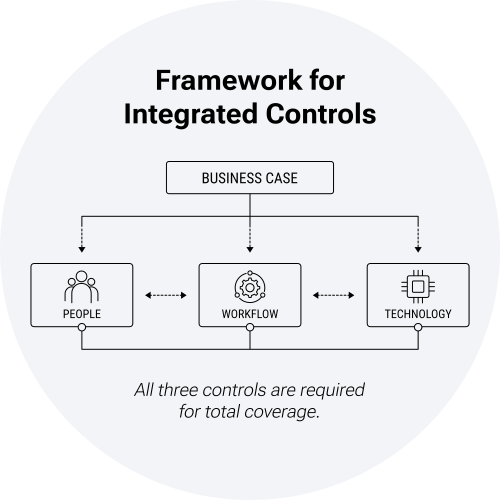
The accompanying diagram 'Framework for Integrated Controls' illustrates how the controls interconnect to deliver total coverage.
Balancing Manual Oversight with Automation
While the table above outlines an optimized control environment, operational reality often requires manual workarounds. For example, if a technology configuration temporarily fails to enforce an automated routing matrix, established manual approval workflows must serve as the critical fail-safe.
However, relying on manual intervention is a temporary stopgap, not a sustainable strategy. As an organization scales, manual oversight quickly becomes inefficient, drains resource capacity, and increases the risk of operational error. Long-term compliance integrity requires moving away from patchwork coverage and continuously aligning culture, workflows, and technology into a scalable governance model.
Summary
When these three areas are properly synchronized, they transform compliance from a regulatory obligation into a reliable framework for secure, scalable corporate growth. If you remove even one component, organizational progress stalls:
- People without Workflows leaves an aligned, ethical team operating without clear direction, leading to inconsistent execution and hidden compliance vulnerabilities.
- Workflows without Technology results in strong designs that have no automated support, forcing slow, manual workarounds that fail as you scale.
- Technology without People
means you have built an incredibly secure system infrastructure, but it operates on autopilot without human oversight or a clear organizational purpose.
By intentionally balancing the people, the workflows, and the technology, an organization secures its financial reporting assets, stabilizes its risk environment, and establishes a sustainable foundation for long-term growth.
Ready to build an ICFR framework that scales with your growth?
Whether you are preparing for your first SOX audit, closing gaps in your current control environment, or preparing for an IPO, building a resilient compliance program doesn't have to stall your business. We help organizations align their people, processes, and technology into a unified, audit-ready framework.