

6/29/2026 ● 2 min 46 sec
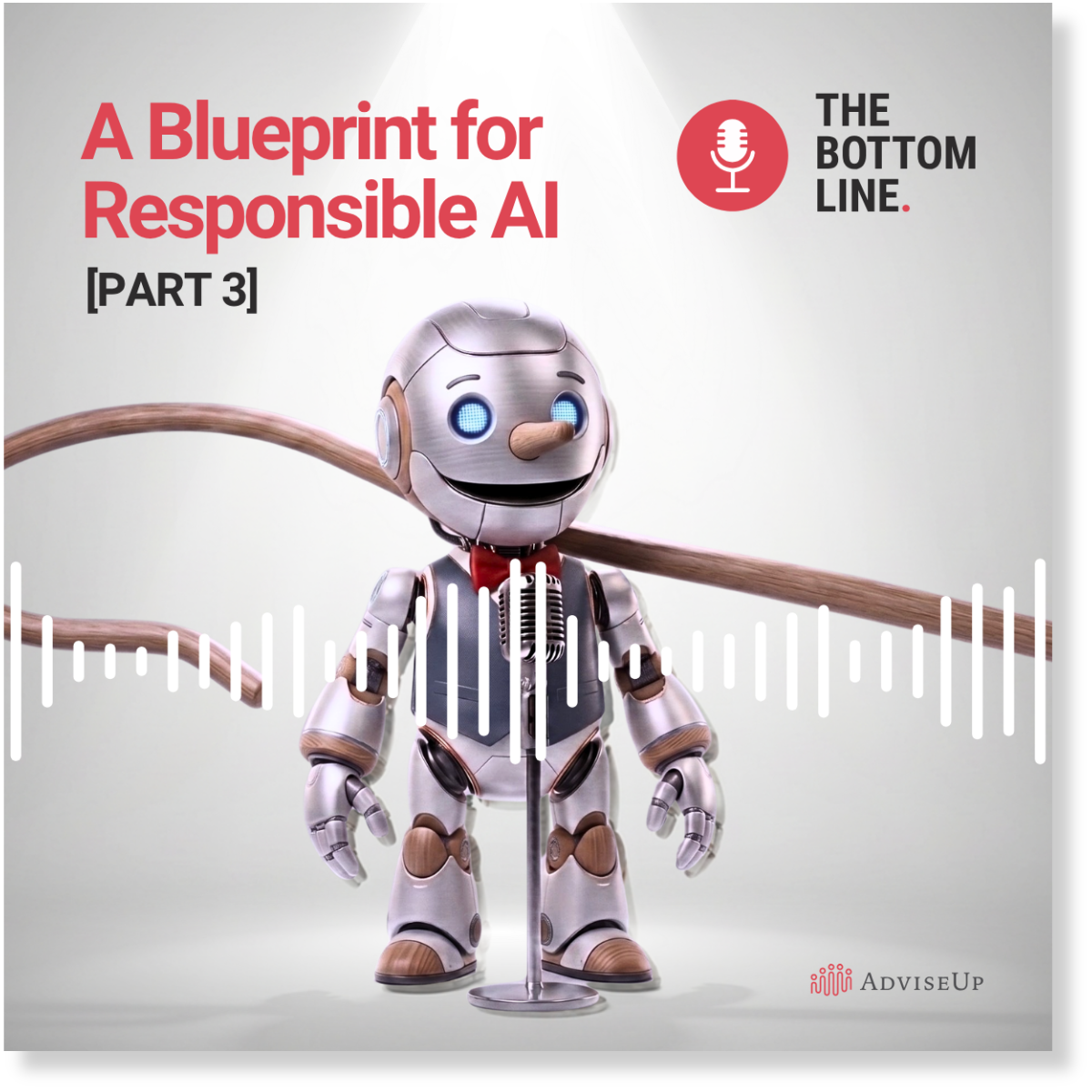
A Blueprint for Responsible AI [Part 3]
How do you move from identifying AI risks to actively managing them? Join Allyson Edwards on The Bottom Line as she outlines the practical framework needed to govern technology responsibly. Discover the four essential controls, ranging from tool inventories to model drift monitoring, that protect your organizational data without stalling innovation. Read the full insight, AI Is Great But Stupid (Part 3): Governing AI.
Read Full Transcript
Hi, I'm Allyson Edwards from AdviseUp Consulting, and this is The Bottom Line.
At this point in our series, AI might be starting to sound more risky than useful. But these challenges aren't a reason to avoid the technology entirely; instead, they're a reason to govern it thoughtfully.
The reality is that AI adoption is happening faster than formal oversight structures. Employees are experimenting with tools independently, integrating AI into existing processes, and entering sensitive data into systems that haven't been fully vetted by leadership.
The biggest misconception about AI governance is that it belongs entirely to your IT department. In reality, AI affects nearly every part of an organization, and the risks differ wildly based on the use case. An AI tool used to summarize meeting notes creates very different operational exposures from one reviewing contracts, analyzing insurance claims, or assisting with hiring decisions. Governance has to account for those differences.
Effective governance starts with visibility. Organizations should already be asking what tools our employees are actually using, what data is being entered, and who validates the outputs?
Once you understand your footprint, you don't need to reinvent the wheel. It’s about adapting existing governance concepts to these new technological risks through four practical controls.
First, approved AI tool inventories. Document exactly which tools are approved, restricted, or prohibited to eliminate unvetted privacy and compliance gaps.
Second, prompt and data handling guidelines. Give employees clear boundaries about what information can be entered into these tools, and how prompts should be structured to protect sensitive data.
Third, access restrictions and permission right-sizing. AI tools can only be constrained by the permissions they are given. If an employee has broad access rights, an AI system operating through their credentials inherits those same capabilities. You must enforce least-privilege access.
And fourth, model drift monitoring. Unlike traditional software, AI systems change over time as models update and input patterns shift. Governance cannot be a one-time implementation exercise; it requires recurring testing and human-in-the-loop validation.
Here is the bottom line, AI governance is not about eliminating risk entirely. We all know that’s a losing proposition. It’s about creating enough structure and oversight to use the technology responsibly while still benefiting from its capabilities.
The businesses that succeed with AI won't be the ones that trust it blindly. They will be the ones that govern it thoughtfully.
Stay tuned for our final installment where we'll pivot from high-level oversight to the daily habits, tips, and tricks that will make your team more effective AI users.
Thanks for joining The Bottom Line.
