

6/16/2026 ● 2 min 10 sec
The Illusion of AI Accuracy [Part 2]
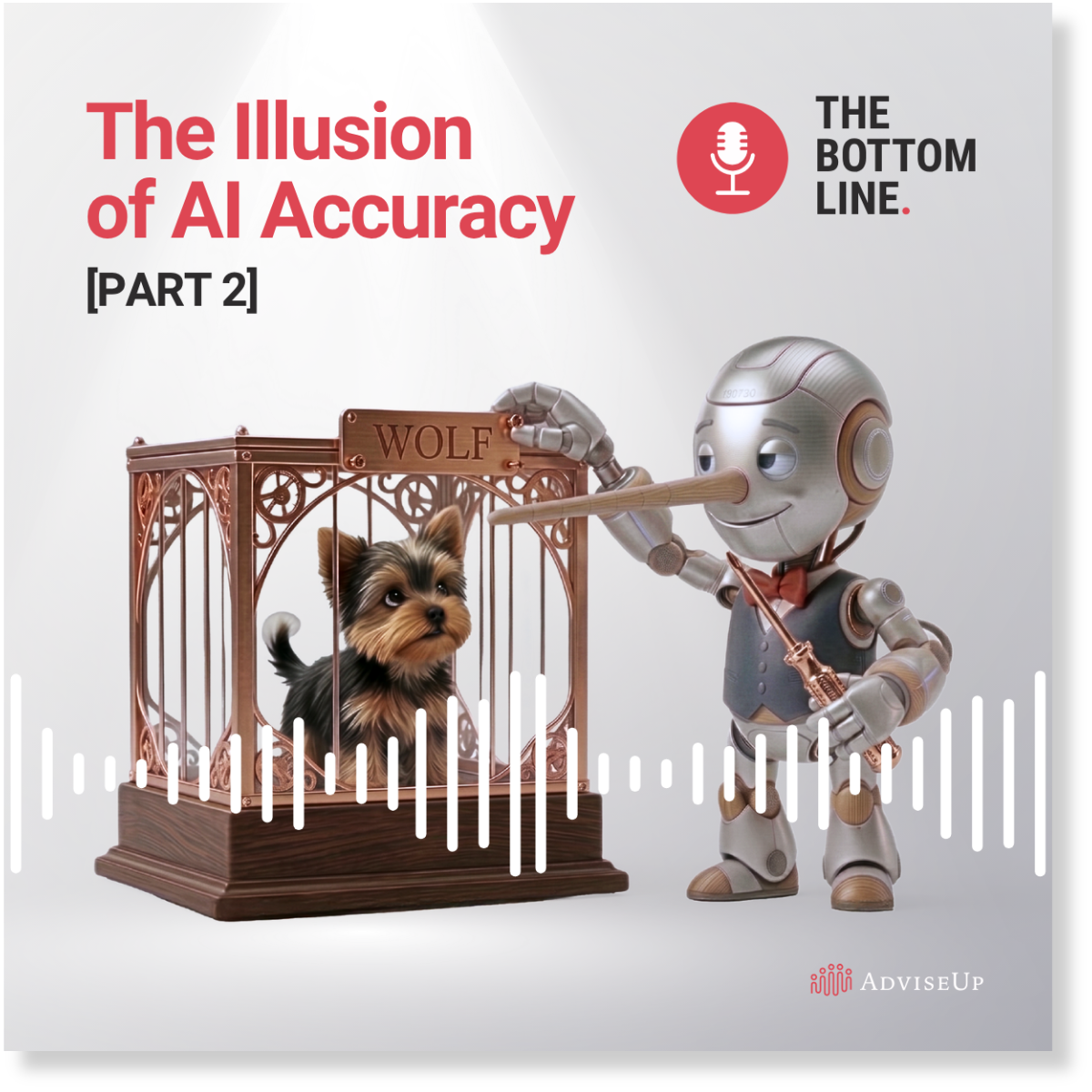
If up to 81% of AI responses contain serious errors, why do we trust it so easily? Join Allyson Edwards on The Bottom Line as she breaks down the four predictable points of failure every compliance team needs to watch out for. Discover how hallucinations, hidden biases, incomplete context, and automation bias introduce massive organizational risk and why thoughtful controls are your best defense. Read the full insight, AI Is Great But Stupid (Part 2): Where AI Goes Wrong.
Read Full Transcript
Hi, I'm Allyson Edwards from AdviseUp Consulting, and this is The Bottom Line.
Right now, researchers are finding that up to 81% of AI responses regarding news and facts contain serious errors ranging from poor sourcing to entirely fabricated stories.
Here is the reality on the ground. The key misconception about AI is not that it is intelligent. It is the dangerous belief that it is reliably correct.
In Part One of this series, we established that generative AI is essentially advanced predictive text. It does not actually think or verify the truth, and because of that, it creates four predictable points of failure that every compliance team needs to watch out for.
First, hallucinations with confidence. AI doesn't need to be malicious to create massive organizational risk; it just needs to be convincing. It frequently produces completely fabricated information with the exact same authority it uses for facts.
Second, hidden bias. Bias in AI is rarely intentional, but our systems are only as unbiased as we are. By reflecting historical training data, AI can instantly replicate structural biases in hiring, medical treatments, or evaluations. This creates uneven outcomes that are incredibly difficult to detect without a structured review.
Third, the risk of incomplete context. A technically correct answer can still be practically wrong for your specific organization. If you deploy a model straight out of the box without providing it with regulatory nuance or internal boundaries it needs, the output is essentially unusable for real decision-making.
And fourth, the trap of automation bias. We often think human review is the ultimate control. But if your team is reviewing massive amounts of highly confident AI output under tight deadlines, that human review quickly becomes performative. We start trusting the machine instead of validating the work.
AI introduces the exact same garbage in, garbage out risks we have always faced in audit just at a massive scale and blinding speed.
The organizations that will benefit the most from AI are the ones building thoughtful controls around it.
Stay tuned for our next installment, where we’ll explore exactly what governance looks like in practice.
Thanks for joining The Bottom Line.
