

5/27/2026 ● 2 min 57 sec
The Reality of Generative AI [Part 1]
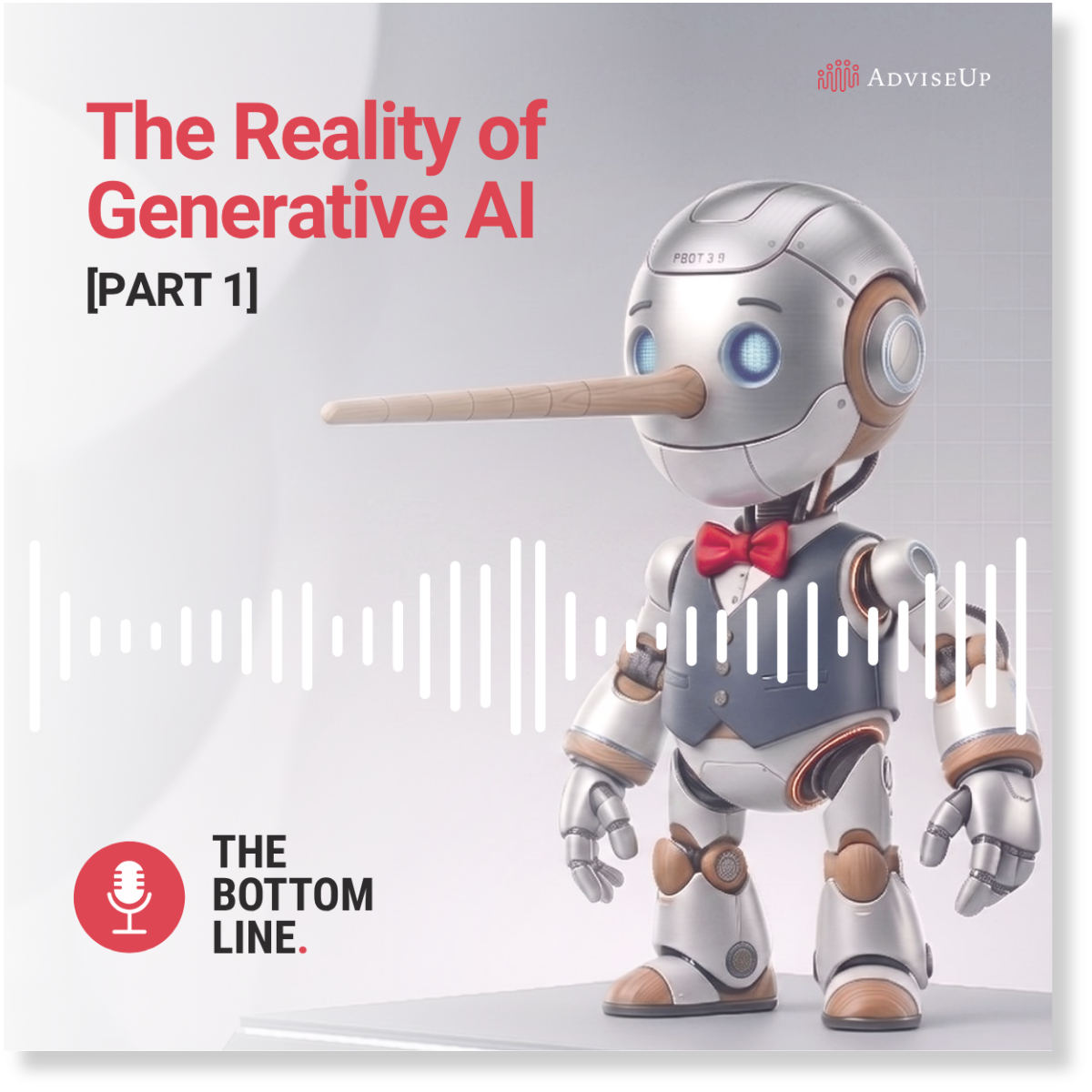
Is your executive team confused about what AI actually is? Join Andrea St. Pierre on The Bottom Line as she breaks down why generative AI is just advanced predictive text, not a reasoning tool. Discover the two critical checkpoints you need to operationalize to protect your organization from the illusion of accuracy. Read the full insight, AI Is Great But Stupid (Part 1): Understanding What AI Actually Is.
Read Full Transcript
I'm Andrea St. Pierre from AdviseUp Consulting, and this is The Bottom Line.
Right now, companies are pouring an exceptional amount of time and capital into new AI strategies, hoping for long term cost savings. But here is the reality on the ground. There is still a surprising amount of confusion at the executive level about what AI actually is, and more importantly, what it isn't.
So, ask yourself, are you deploying a strategic risk tool, or are you inadvertently building a process around a highly confident algorithm?
Modern generative AI systems don't reason or understand information in the human sense. Instead, they identify patterns in massive datasets and generate responses based on probabilities. Simply put, AI is an extremely advanced predictive text.
It’s a lot like taking a toddler to the zoo. If they see a wolf, they're likely to call it a "doggie" because statistically, that's the animal they know best. AI does the exact same thing at scale. It produces outputs that look incredibly thoughtful because it mimics human language, but it doesn’t actually understand meaning, intent, or the truth.
To protect your organization and use AI safely, you need to operationalize these two checkpoints.
First, shift to verification. Because AI mimics human language so well, it creates a dangerous illusion of accuracy. Don't just trust the output. Establish an evidence based process to validate that every response is grounded in fact, not just a probability.
Second, recognize the mimicry. Stop assuming the tool "understands" the policies or regulations it summarizes. It does not. It predicts, structures, and mimics based purely on probability and patterns.
Understanding what AI actually is lays the foundation for how it can be governed effectively. A tool cannot replace a culture of diligence. Focus on improving your risk processes from the inside out before handing the wheel over to the tech.
Stay tuned, because this is just part one of our series. In our next installment, we will be walking through exactly where things go off the rails.
Thank you for listening to the Bottom Line, and have a great day.
